MiamiValleyDreamHomes.com Blog - Your Ultimate Source for Real Estate News, Insights, and Tips in the Greater Dayton Area of Ohio

Welcome to our real estate blog on MiamiValleyDreamHomes.com, your ultimate source for real estate news, insights, and tips in southwest Ohio! Whether you're a first-time homebuyer or a seasoned investor, our blog is designed to provide you with the latest news and trends in the Miami Valley real estate market, as well as insider tips and advice to help you navigate the buying or selling process with confidence.

With our team of expert Realtors, including top Dayton realtors and the best Beavercreek listing agent with great online reviews, you can rest assured that you're in good hands. We're committed to providing you with a stress-free and seamless real estate experience, whether you're buying, selling, or just looking for valuable insights about the local market.

So what are you waiting for? Start exploring our blog today and discover why MiamiValleyDreamHomes.com is the top choice for real estate buyers and sellers in the Miami Valley area!


Feb. 5, 2026

Commercial Real Estate in Dayton, Ohio: Market Paths & Property Choices

Dayton’s commercial real estate market offers diverse options for businesses, investors, and developers, from renovated downtown suites to large industrial campuses along major highways. The region's affordable, steady-demand environment supports enterprises at various growth stages.

Miami Valley Dream Homes draws on deep local insight to help you identify properties that align with your operational goals, preferred locations, and long-term plans. Their understanding of Dayton’s evolving submarkets helps you focus on spaces that support stability and future expansion.

This guide explores key market trends, leasing and buying factors, major property types, and the neighborhoods shaping current demand. You’ll find practical steps for touring, evaluating, and negotiating commercial spaces across the Dayton area.

Commercial Real Estate Market Overview in Dayton

Dayton’s commercial market shows falling vacancies, stronger suburban demand, and steady rent growth. You’ll find more affordable Class B and C offices, pockets of high-priced suburban Class A space, and many listings on major exchange platforms.

Key Trends and Developments

Vacancy improved from about 23% to near 18% after some office buildings were removed from the inventory for conversion. Tenants have relocated to suburban campuses or smaller, flexible spaces, resulting in positive net absorption.

Lease rates rose modestly to roughly $17.80 per square foot citywide. Suburban Class A space commands the highest rents, while downtown Class A still faces a high vacancy over 40%.

Developers focus on adaptive reuse—turning office buildings into housing or hospitality—to reduce office supply. This trend helps lower vacancy but shifts investment to mixed-use projects and suburban office parks.

Major Property Types Available

You can choose among office, retail, industrial, and multi-family assets across Dayton. Office space ranges from CBD Class A towers to smaller Class B and C suburban buildings that offer lower rents and flexible floor plans.

Industrial and warehouse space remains attractive near transportation links and the airport. Retail availability concentrates along major corridors and neighborhood centers. Multifamily properties draw investor interest where housing demand is steady.

Class B and C offices offer yield potential with modest renovation. Suburban Class A gives newer amenities at a higher cost. Search by property type to match budget and operational needs.

Leading Real Estate Exchange Platforms

You can find most Dayton listings on major commercial platforms and local broker sites. National sites such as Crexi, LoopNet, CityFeet, and Realmo show photos, square footage, and contact info.

Local brokerages list pocket opportunities and off-market deals. Use these for deeper local knowledge and negotiated terms.

When searching, filter by property type, size, rent or price per square foot, and submarket. Save searches and set alerts so you don’t miss new Dayton commercial real estate listings or price changes.

Leasing Commercial Properties in Dayton

You’ll find a range of office, retail, and industrial spaces across Dayton that fit small startups to mid-sized firms. Focus on location, lease type, and total monthly costs to match your business needs.

Popular Locations for Leasing

Downtown Dayton (Wayne Ave, Patterson Blvd, 3rd St) suits professional offices and retail that rely on foot traffic and nearby amenities. Buildings there often offer flexible small-suite options and easy highway access.

Dayton suburbs like Centerville Business Parkway and Wilmington Pike host corporate offices, medical suites, and light industrial space with more parking and lower street congestion. These areas work well if your staff drives or if you need loading access.

Industrial and warehouse markets cluster around Executive Blvd and McEwen Rd. You’ll see large floor plates (15,000–100,000+ sq ft) and yard space for logistics or distribution. Pick locations near I-75 or I-70 for faster freight routes.

Typical Lease Rates and Terms

Lease rates in Dayton vary by property type: average office rates are around $14/SF/year, retail near $15/SF/year, and industrial about $10/SF/year. Smaller downtown suites often list per-month pricing, while larger leases use $/SF/year with CAM and utilities added.

  • Triple Net (NNN): You pay base rent plus property taxes, insurance, and maintenance.
  • Full Service (Gross): Landlord covers most operating costs; you pay a higher base rent.
  • Modified Gross: Costs split based on negotiation.

Expect lease terms from 2 to 10 years. Shorter terms suit startups testing a market; longer terms lower annual rent and may allow tenant improvement (TI) allowances. Always calculate total occupancy cost: base rent + NNN or operating costs + TI amortization + utilities + parking.

Lease Negotiation Tips

Start by knowing comparable rents and vacancy rates for your target neighborhood. Use listings and broker data to set a realistic rent target. Ask for specific tenant improvements and get TI allowances in writing. 

Clarify who pays for build-out, permits, and long-term maintenance of shared systems like HVAC. Negotiate key clauses: renewal options, rent escalations (fixed or CPI), sublease rights, and termination or expansion rights. 

Limit your exposure by capping annual CAM increases and defining acceptable CAM expenses.  Hire a commercial broker or attorney experienced in Dayton commercial real estate to review terms. Their local knowledge helps you spot hidden costs and craft clauses that protect your cash flow.

Buying Commercial Real Estate in Dayton, Ohio

You will find offices, retail, industrial, and multifamily buildings across Dayton, plus vacant land and mixed-use sites. Know what type fits your budget, cash flow goals, and location needs before you start touring properties.

Financing Considerations for Commercial Buyers

Lenders review property income, borrower financials, and market stability before approving commercial loans. The U.S. Small Business Administration notes that SBA 504 and 7(a) loans can support purchases, renovations, and long-term equipment needs.

Comparing loan types, down payment requirements, and amortization schedules helps you structure deals with clearer cash flow expectations. Early discussions with lenders strengthen offers and shorten timelines.

Property for Sale Types

Dayton listings include: office suites downtown and in suburbs, street-front retail in neighborhood centers, industrial warehouses near I-75, and apartment buildings across core neighborhoods. Land parcels for development appear along growing corridors like Wilmington Pike and along transit routes.

Look at the size and condition first. Offices range from small 1,500–10,000+ sq ft suites to multi-tenant buildings. Industrial spaces vary by clear height, dock count, and yard space. Retail needs visibility, parking, and local demand. Multifamily value ties to unit mix, occupancy, and rent levels.

Check zoning, utility access, and environmental reports early. Those items affect use, permitting, and financing. Work with a local broker to see current listings and comparables so you can judge realistic price and rent expectations.

Investment Opportunities

You can pursue income, value-add, or land-development plays in Dayton. Income properties, like stabilized apartment buildings or leased retail, give steady cash flow and easier financing. Value-add requires renovation or operational fixes to boost rents and property value.

Land or redevelopment projects offer a bigger upside but need zoning changes, entitlements, and longer timelines. Watch local market drivers: employment centers, university activity, and public projects that drive demand. 

Compare cap rates, cash-on-cash returns, and occupancy trends across property types. Consider tax abatements or incentives from local economic development groups for redevelopment or job-creating projects. Factor in operating costs and management needs. 

Multifamily needs active leasing and maintenance. Industrial and large retail often need less hands-on management but may have higher insurance or site costs. Use pro forma scenarios for conservative and optimistic rent growth to test returns.

Acquisition Process Overview

Start with a clear checklist: property type, target neighborhoods, price range, required returns, and financing strategy. Engage a commercial broker, commercial lender, and attorney experienced in Dayton deals. They help find listings, arrange viewings, and prepare offers.

Typical steps: property tour, review financials and leases, order inspections and environmental studies, secure financing commitment, negotiate purchase agreement, and close after title and due diligence. Expect 30–90 days between accepted offer and closing, longer for complex entitlements.

Budget for earnest money, inspection fees, appraisal, title work, and closing costs. If you plan renovations, include contingency funds. Keep communication tight with lenders and city permitting offices to avoid delays.

Key Property Types in the Dayton Market

Dayton’s market includes a range of property types that match different business needs and investment goals. You’ll find options from small professional suites to large industrial buildings and build-ready land.

Office Spaces and Suites

You can choose traditional downtown Class B office buildings, suburban professional suites, or flexible coworking spaces in Dayton. Downtown and nearby suburbs such as Centerville and Kettering host multi-tenant office buildings with surface parking and easy access to I-75 and major arterials.

Smaller suites (1,000–5,000 sq ft) often suit local firms, medical practices, or startups. Larger floorplates (10,000+ sq ft) work for regional headquarters or back-office operations. Leasing terms vary, but you’ll commonly see modified gross or full-service leases for multi-tenant buildings.

If you’re buying, consider building age, HVAC, and parking ratios. Proximity to transit, nearby amenities, and zoning for professional services matter for tenant demand and resale value.

Retail and Mixed-Use Properties

Retail in Dayton ranges from street-front storefronts and neighborhood strip centers to power centers near major highways. Mixed-use properties combine ground-floor retail with upper-level apartments or offices, common around walkable nodes and revitalized corridors.

Evaluate traffic counts, visibility, and parking when assessing retail. Anchors like grocery stores or large service tenants significantly affect foot traffic and lease stability. For mixed-use, check zoning that allows residential density above retail and whether the property includes entitlements.

Tenant mix, signage rights, and CAM charges influence net operating income. Look at demographic data like household income and daytime population to gauge demand for retail concepts.

Industrial and Warehouse Facilities

Dayton’s industrial market supports light manufacturing, distribution, and logistics tied to I-75 and regional road networks. You’ll find small flex buildings (5,000–20,000 sq ft), larger warehouses (50,000–200,000+ sq ft), and rail-served sites.

Key factors include clear height, dock door count, column spacing, and truck access. If you’re leasing, confirm floor load capacity and power availability for machinery. If you’re buying, inspect the site drainage, yard space for trailers, and any environmental records.

Proximity to logistics nodes and airports speeds shipping. Modern tenants often require higher ceilings and more office buildout inside industrial shells, so plan capex accordingly.

Commercial Land and Development Sites

Vacant commercial land and infill lots offer opportunities for retail centers, office buildings, or mixed-use developments. You’ll see parcels near major intersections and industrial parks marketed as build-ready or needing rezoning.

When evaluating land, check zoning classification, permitted uses, and utility access (water, sewer, electric). Traffic impact studies and stormwater requirements can affect site feasibility. For larger sites, environmental Phase I/II reports and soil tests matter for financing and site costs.

If you want to develop, confirm local incentives, tax abatements, and any public infrastructure plans. Location near major corridors or existing development makes leasing or sale easier after construction.

Top Neighborhoods and Surrounding Areas

Dayton offers a mix of dense urban cores, growing industrial corridors, and nearby cities that feed demand for commercial real estate. You’ll find options for office, retail, industrial, and mixed-use projects with easy access to major highways and a strong aerospace employment base.

Downtown Dayton Hotspots

The central business district around Courthouse Square and the Oregon District features office buildings, restaurants, and entertainment venues. This area is ideal if you want walkable access for clients and steady evening foot traffic.

Historic brick buildings near Fifth Street and Main Street now house small offices, creative firms, and boutique retail. These spaces attract tenants who seek character and lower rents compared to bigger metro areas.

The Oregon District offers restaurants, bars, and street-level retail that increase nighttime and weekend activity. For professional services, consider newer Class A or renovated Class B spaces along Ludlow and the riverfront redevelopment near the Schuster Center.

Public transit and surface parking are available, but check parking ratios if your business relies on client visits.

Emerging Commercial Districts

Interstate 75 corridors north and south of Dayton attract industrial and logistics businesses. You can find warehouse, distribution, and light manufacturing sites near I-75 interchanges for fast regional trucking access.

Suburban office parks in Kettering, Beavercreek, and Centerville provide modern layouts and campus-style amenities. These areas benefit firms looking for suburban parking and convenient employee commutes.

Retail continues to expand around major shopping centers on Wilmington Pike and Austin Landing in Miamisburg. Land for new development remains available near these areas, allowing for ground-up projects or infill redevelopment.

Seek properties with good truck access, proximity to Wright-Patterson AFB, and strong utility capacity if you plan industrial or aerospace-related uses.

Nearby Cities and Growth Regions

The Dayton metro area spans Montgomery, Greene, Butler, and Warren counties, connecting you to places like Kettering, Beavercreek, and Springfield. These suburbs supply office and retail demand from growing households and stable employment centers.

Wright-Patterson Air Force Base anchors aerospace jobs that support suppliers and service firms across the region, creating steady demand for leased industrial space and specialized offices.

Dayton’s location places you within a day’s drive of Cincinnati, Columbus, Indianapolis, and Pittsburgh. For regional distribution, choose sites with I-75 or I-70 access to reach those markets quickly.

Consider Miamisburg and Franklin for industrial land, and Centerville or Oakwood for higher-end professional office users.

Finding Your Ideal Commercial Space in Dayton

Dayton provides a range of commercial opportunities suited to businesses, investors, and developers who want flexibility and value. When you understand local trends and property types, it becomes easier to choose spaces that support both immediate needs and long-term plans.

Miami Valley Dream Homes applies its knowledge of Dayton’s commercial corridors to help you pinpoint properties that match your objectives. Their local perspective brings clarity to the search, whether you need a downtown suite, a suburban office, or a large industrial site.

If you’re ready to explore commercial options or compare submarkets, connect with our team to begin mapping your next steps.

Frequently Asked Questions

This section covers practical steps, where to look, lease and purchase options, special rules for vacant or abandoned buildings, and local resources you can use. Each answer points to actions, contacts, or places in Dayton that help you move forward.

What are the steps involved in purchasing commercial real estate in Dayton?

Define your budget and property type, confirm zoning, hire qualified professionals, complete inspections and title checks, secure financing, and finalize closing terms.

How can I find affordable commercial properties for sale in Dayton?

Check commercial listing platforms, contact local brokers for opportunities, and consider older or emerging areas. Review auction options carefully due to rehab costs.

What options are available for commercial real estate rentals in Dayton?

Dayton offers office, retail, industrial, and mixed-use spaces with various lease structures. Compare terms, building conditions, and operating costs before committing.

How do I negotiate a commercial property lease in Dayton?


Know local market rents, clarify responsibilities and lease length, request concessions or improvements, and have all terms reviewed by a qualified attorney.

Posted in Real estate
Feb. 3, 2026

Bellbrook, Ohio Homes and Community Insights for Informed Buyers

Bellbrook offers a calm, welcoming setting with easy access to Dayton and the rolling countryside that defines the Miami Valley. Its real estate market blends established neighborhoods, newer developments, and natural scenery that creates an appealing pace of living for many buyers. 

Working with Miami Valley Dream Homes, part of Keller Williams Community Partners Realty, offers insight into Bellbrook homes' day-to-day living. Our approach centers on clarity, care, and steady guidance so you can explore the market with confidence rather than pressure. 

In this guide, you’ll learn how Bellbrook’s market behaves, what home styles you can expect, and how buyers navigate inventory and pricing. You’ll see practical steps to search effectively, understand legal basics, and move from interest to closing with a calm, informed plan. 

Bellbrook, Ohio, Real Estate Market Overview

Bellbrook's market features competitive demand, mixed listing counts, and home prices that vary by neighborhood and home type. You’ll find a mix of newer subdivisions and established homes close to schools and Dayton-area commuting routes.

Current Housing Trends

Steady buyer interest in Bellbrook comes from families seeking good schools and short commutes to Dayton. Local listings move quickly compared with many nearby towns, and multiple offers are possible on well-priced, updated homes.

Inventory has tightened at times, giving sellers an advantage for move-in-ready properties and homes near top-rated schools. Demand favors homes with updated kitchens, finished basements, and two-car garages.

How Seasonal Shifts Influence Bellbrook Buyer Activity

Bellbrook tends to follow broader Midwest seasonal patterns, with early spring and late summer often showing more active listing and showing traffic. These cycles can shape how you time a purchase, especially if you want to compare multiple homes before deciding. 

According to the National Association of Realtors, seasonal momentum varies with weather, job changes, and school calendars, all of which influence buyer flow.

When reviewing local inventory, expect winter months to offer fewer choices but potentially more negotiation room depending on property condition and price. As spring arrives, interest increases, and well-presented homes may receive offers more quickly. 

Understanding these rhythms allows you to set reasonable expectations and plan your preapproval timelines with less stress.

As you prepare, watch days-on-market and list-to-sale price trends for Bellbrook and nearby communities, such as Centerville. These comparisons help you see how seasonality affects pricing ranges and buyer competition across the greater region.

Average Home Prices

Recent data places median or average home prices in Bellbrook in the low-to-mid $300,000s to around $470,000, depending on neighborhood and dataset. Smaller, older homes often list below the median, while newer builds and homes on larger lots tend to push the price higher.

Price trends show modest year-over-year changes. Buyers should set a clear budget and watch comparable sales. Sellers should use local comps to price competitively.

Homes for Sale Inventory

Inventory in Bellbrook is limited compared with larger metro areas, with single-digit to low-double-digit active listings common in many months. You’ll often find 1–3 bedroom starter homes, 3–4 bedroom family homes, and fewer new construction lots available.

Use MLS access for the most current listings and photos. If you want a specific school zone, lot size, or recent remodel, be prepared to act quickly and have financing or a pre-approval ready.

Types of Homes for Sale in Bellbrook

Bellbrook offers a range of home styles, from classic single-family houses to low-maintenance condos and high-end estates. Listings show options at many price points and lot sizes.

Single Family Homes

Single-family homes make up most of Bellbrook’s market. Expect 3–5 bedroom houses on lots from about 0.2 to over 1 acre, with attached garages, finished basements, and yards. Many were built between the 1970s and 2000s, though newer subdivisions offer modern open plans and higher-end finishes.

Prices often range from the low $200ks for smaller, older homes to $500k+ for larger, updated houses. When searching, filter by lot size, finished square feet, and school district to match your needs. Pay attention to the basement condition and the roof age when touring.

Townhomes and Condos

Townhomes and condos provide lower-maintenance living in Bellbrook. These units usually offer 2–3 bedrooms, one or two baths, and smaller footprints, ideal if you want less yard work. Condos often include HOA fees that cover exterior maintenance, snow removal, and common areas.

Prices commonly fall below single-family comparables, making them a good entry point if you want to stay in town. Check HOA rules, fee amounts, and what the fees cover. Also, confirm parking availability and any rental restrictions if you plan to rent the unit later.

Luxury Properties

Luxury properties in Bellbrook are larger homes with premium features and bigger lots. You’ll see 4+ bedroom houses with high-end kitchens, multiple living areas, custom finishes, and landscaping. Some estates include acreage, in-ground pools, or finished multi-level garages.

Expect prices from the high $400ks to well over $1M for top-tier listings. Use searches to narrow by price, square footage, and amenities like pools or guest suites. For luxury buys, work with a local agent familiar with negotiations, inspections, and any special neighborhood covenants.

Real Estate Representation Options in Bellbrook

Bellbrook buyers and sellers can choose among a range of real estate service styles, from community-focused agents to established teams with deeper marketing infrastructure. Each approach offers different benefits depending on your goals. 

Whether you want close neighborhood insight, broad-market exposure, or guidance through today’s Miami Valley market pace. Understanding these options helps you choose representation that fits the level of support and communication you prefer.

Meet Don and Cindy Shurts

Clients consistently describe Don and Cindy Shurts as steady, attentive professionals who combine clear communication with genuine care for the people they serve. 

Reviews praise their patience, responsiveness, and skill in simplifying complex decisions, helping clients stay grounded during buying and selling. Their approach shows long-term Miami Valley experience and a shared goal to make each step clear and manageable.

Don Shurts

Don brings a detail-oriented, analytical style shaped by years of hands-on real estate work and deep familiarity with the area’s neighborhoods. He focuses on helping clients interpret pricing, property conditions, and market trends so they can move forward with well-informed decisions.

His guidance emphasizes clarity, preparation, and thoughtful pacing, allowing clients to navigate both routine and unexpected moments with confidence.

Cindy Shurts

Cindy brings a strong, client-focused approach that supports smooth transitions from one phase of a transaction to the next. She is known for her reliable communication and practical problem-solving. 

Additionally, she has the ability to keep clients informed without overwhelming them. Clients often note her calm presence and steady follow-through, which helps maintain a sense of assurance during important deadlines and decision points.

Bellbrook Home Buying Process

Find a home by targeting neighborhoods, using local MLS/IDX feeds, and lining up financing first. Once you pick a property, make a clean offer that matches local speed and custom, then move quickly through inspections and lender requirements to close.

Finding the Right Property

Set a clear budget and get preapproved. Use MLS/IDX search tools to filter Bellbrook listings by price, school district, and lot size. Save searches for homes under $325k for entry-level inventory; expand to $350–400k for newer or larger homes.

Drive the streets you like at different times of day. Look for roof age, sidewalk condition, and proximity to WPAFB commute routes. 

Ask your agent for recent comparable sales within the same ZIP code and for seller disclosure histories. If a listing has a paid water-softener or recent roof work, get copies of receipts. These small facts help you compare value quickly.

Making an Offer

Work with a local agent who knows Bellbrook bidding patterns. Offers under $350k often need escalation strategies and clean contingencies. Include a preapproval letter and a short, factual buyer letter about what you like in the home.

Decide on earnest money and inspection timelines up front. Typical requests: 10–14 day inspection period and 30–45 day closing. 

Use an escalation clause if competing, and cap it at your maximum. If you want the washer/dryer or a softener left, list those as specific line items. Have your agent submit offers via the Dayton Area Board of REALTORS® transaction platform for official records.

Closing on a Home

After inspection, negotiate repairs or credits in writing. For Bellbrook houses, expect radon testing and a roof-age check; budget for minor pest or soffit fixes. Finalize your mortgage lock once the appraisal comes in and clear any lender conditions quickly.

Order the title and survey early. Bring photo ID, proof of homeowners' insurance, and wire-transfer instructions to closing. 

Confirm the closing agent will post documents to MLS/IDX records so the sale shows accurately. On signing day, review the HUD/Closing Disclosure line by line, then pay closing costs and receive keys.

Legal Considerations and Fair Housing in Bellbrook

Follow federal and state rules when buying, selling, or renting in Bellbrook. These laws protect specific groups, set broker duties, and give you places to file complaints if you face discrimination.

Fair Housing Act Protections

The federal Fair Housing Act bars discrimination in housing based on race, color, religion, sex, national origin, familial status, and disability. Landlords, sellers, and agents cannot refuse to rent or sell, set different terms, or steer you to certain neighborhoods for those reasons. 

You also have rights to reasonable accommodations and modifications if you have a disability, such as a parking space or a grab bar, and providers must consider these requests.

If you believe someone violated these rules in Bellbrook, you can file a complaint with HUD or the U.S. Department of Justice. Keep records: dates, names, ads, messages, and written notices help support your claim.

Equal Opportunity Act Compliance

Ohio enforces similar protections and adds local oversight. Real estate licensees must display required fair housing notices in their offices and include fair housing language in agency agreements for covered properties. 

The Dayton Area Board of Realtors follows national and state rules and expects members to avoid discriminatory practices in listings, advertising, and client treatment.

You can report violations to the Ohio Civil Rights Commission, the Ohio Division of Real Estate, or the Dayton Area Board of Realtors if a member breaks conduct rules. For faster action, submit written complaints with copies of ads, emails, or lease offers.

Moving Forward With Clarity in Bellbrook’s Real Estate Landscape

Bellbrook offers a welcoming mix of comfortable neighborhoods, steady market activity, and homes that suit a wide range of lifestyles. Understanding inventory patterns, local pricing, and the buying process helps you approach your search with clarity and calm decision-making. 

Miami Valley Dream Homes, part of Keller Williams Community Partners Realty, emphasizes thoughtful guidance rooted in local knowledge. Our role is to help you compare options, understand each step, and move through the process with steady support. 

If you’re ready to explore Bellbrook homes or want a clearer view of current market conditions, reach out for local guidance today. We’ll help you evaluate options, understand next steps, and discover whether Bellbrook feels like the right place to begin your next chapter.

Frequently Asked Questions

You will see a range of prices, nearby comparisons, and both move-in-ready homes and some vacant land. The answers below give quick facts on pricing, property types, lot sizes, and why people choose to live in Bellbrook.

What's the average home price in Bellbrook, Ohio, right now?

The median list price per square foot in Bellbrook is about $206 based on recent listings. Typical asking prices range widely, roughly from $210,000 up to around $1,600,000, depending on size and location.

Prices change with market activity, so check current MLS or local realtor sites for the latest numbers.

Are there any homes for sale by owner in Bellbrook?

You may find a few for-sale-by-owner (FSBO) listings from time to time. Most homes appear through MLS and local brokerages, so use search tools and agents to spot FSBO opportunities.

How does the real estate market in Bellbrook compare to neighboring areas like Centerville and Sugarcreek Township?

Bellbrook usually lists homes at mid-to-upper price ranges for the area, with steady demand for single-family properties. Centerville often features higher-priced, denser neighborhoods and more new construction. 

Sugarcreek Township tends to offer larger lots and a more rural atmosphere. Neighborhood, school district, and home age all affect comparisons. Review recent sales and price per square foot for the most accurate view.

Can you find land for sale in Bellbrook, and what are the typical lot sizes?


Occasional vacant lots and small parcels come up for sale in and around Bellbrook. Typical lot sizes in town range from modest infill lots under half an acre to suburban lots around 0.5–1 acre. Larger acreage parcels are rare inside city limits. Look to bordering townships for bigger tracts.

Feb. 2, 2026

Miami Valley Real Estate Market 2026: December Sales Surge & What It Means Locally

2026 Housing Market Update for Dayton & the Miami Valley: Buyers Aren’t Waiting for Spring

If you’ve been thinking, “We’ll wait until spring,” the market may already be moving without you.

Nationally, existing-home sales ended 2025 with a meaningful jolt of momentum. The National Association of REALTORS® reported that existing-home sales rose 5.1% in December to a 4.35 million seasonally adjusted annual rate—an end-of-year finish that surprised a lot of people.


And here at home in the Miami Valley, the local numbers show the same theme: activity picked up as 2026 approached, and serious buyers were still out shopping in December.

December’s message is clear: the “spring market” is starting earlier

In the NAR release, Chief Economist Lawrence Yun noted that “December home sales… were the strongest in nearly three years.”

That lines up with what many local buyers and sellers are feeling: people aren’t waiting for perfect conditions anymore. They’re making moves when the right home (or the right plan) shows up.

National snapshot (why the headlines matter)

NAR’s December 2025 report highlighted:

  • Median existing-home price: $405,400 (up 0.4% year over year)

  • Inventory: 1.18 million homes, about 3.3 months of supply

  • Mortgage rates: NAR cited Freddie Mac data showing the average 30-year fixed was 6.19% in December

Even more recently, Freddie Mac’s weekly survey showed the average 30-year fixed rate at 6.10% as of January 29, 2026, still hovering near the lowest levels in more than three years.

Dayton Ohio Real Estate Market Update

What the latest numbers look like locally in Dayton-area home sales

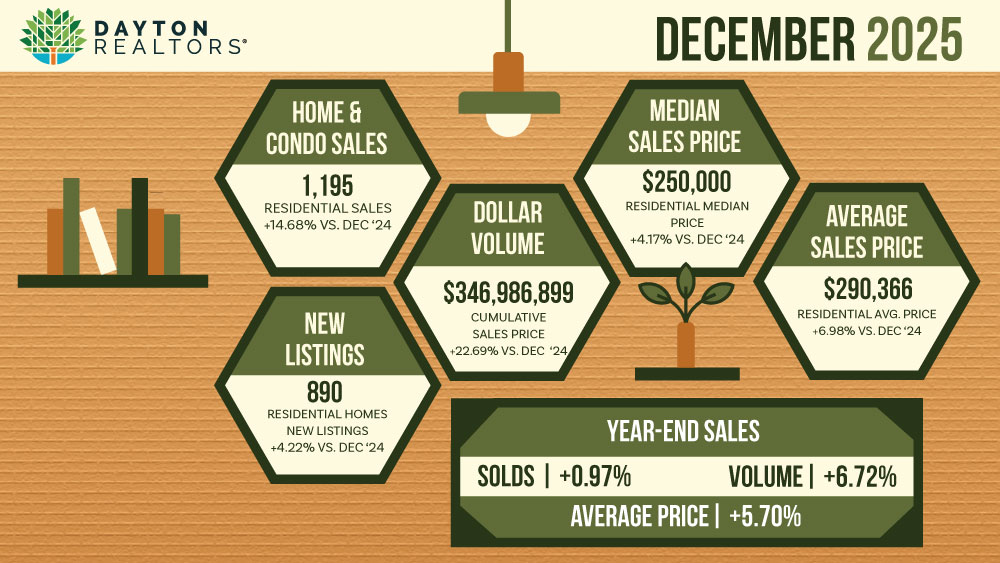
The Dayton REALTORS® year-end update showed a market that stayed competitive but also gained momentum late in the year. For December 2025 specifically:

  • Sales increased 14% year over year

  • Listings increased 4%

  • Median sale price: $250,000

  • Average sale price: $290,366

For full-year 2025, Dayton REALTORS® reported:

  • Median sale price: $255,000 (up 6%)

  • Average sale price: $293,404 (up 5%+)

  • Sale-to-list ratio: about 99.7%

  • Inventory: roughly 1.8 months supply at year end

That last stat matters: 1.8 months of supply is still tight. In many Miami Valley neighborhoods, well-prepped, well-priced homes can move fast—regardless of the season.

Is 2026 shifting toward buyers… or still a seller market?

Nationally, buyers have gained greater negotiating power in many markets—often through price reductions or concessions. Redfin reported that in December 2025, the typical home sold for 1.8% less than its final list price, and only 22% sold above list (the lowest December share since 2019).

But here’s the local nuance: in the Dayton MLS data, the market is still showing strong sale-to-list performance (December around 98.8%), and inventory remains lean.
While buyers may have more opportunities to negotiate in certain situations, the best homes can still attract strong competition.

What this means for buyers in 2026

If you’re planning to buy in Dayton, Beavercreek, Centerville, Fairborn, Springboro, or the surrounding Miami Valley communities, a “smart early start” can be a big advantage.

A few practical moves:

  • Get fully pre-approved (not just pre-qualified) so you can move quickly when the right home hits.

  • Watch February closely. NAR specifically expects more inventory to come to market beginning in February.

  • Be strategic, not rushed: some sellers will negotiate, but the most desirable homes (location/condition/price) still go fast in tight-inventory areas.

What this means for sellers in 2026

If buyers aren’t waiting for spring, sellers don’t have to either.

Listing before the spring surge can mean:

  • Less competition from other sellers who wait until March/April

  • More attention from serious buyers who are already active

  • Stronger positioning when you price correctly and present the home well

The big takeaway from the latest local data: buyers are still paying close to the asking price on average, but they’re also more selective—so presentation, pricing, and marketing matter more than ever.

Moving to the Dayton area in 2026

We also work with many relocation buyers—especially those connected to Wright-Patterson Air Force Base and regional healthcare systems like Kettering Health. If that’s you, the best approach is simple: match your timeline to the neighborhoods and price points where inventory tends to be tight, and get ahead of the “spring rush” while options are still opening up.

Bottom line: the market is moving—let’s plan around it

December didn’t just close out 2025—it kicked off 2026 with momentum. National sales improved, rates eased from prior highs, and locally, we saw a meaningful bump in Dayton-area activity.

If you’re thinking about buying or selling a home in the Miami Valley in 2026, we’d love to help you build a clear plan (and timing strategy) based on your neighborhood and goals.


Call or text Don & Cyndi Shurts
Keller Williams Community Partners Realty
📱 937-241-2124 | 937-604-5194

Jan. 30, 2026

Don & Cyndi Shurts Named 2026 Top Agent in Fairborn, Ohio | Real Results, Proven Experience

Don & Cyndi Shurts Named 2026 Top Agent in Fairborn, Ohio

Top Fairborn Real Estate Agent

A Recognition Built on Experience, Trust, and Real Results

In real estate, recognition only matters if it reflects real performance.

That’s why being named a 2026 Top Agent in Fairborn, Ohio by FastExpert is especially meaningful for Don & Cyndi Shurts. This designation isn’t based on advertising, popularity, or paid placement—it’s earned through data, consistency, and results.

For Fairborn buyers and sellers, it confirms what many already know: experience matters, guidance matters, and results follow when the right professionals are in your corner.


What Makes the FastExpert Top Agent Award Different

FastExpert is a nationally recognized real estate platform trusted by more than 500,000 consumers since 2014. Unlike “best agent” lists that rely on self-promotion, FastExpert analyzes millions of real estate transactions nationwide to identify agents who consistently perform at a high level.

Rankings are determined by:

  • Verified sales history

  • Client reviews and satisfaction

  • Responsiveness and reliability

  • Consistency over time

Agents cannot pay to improve their rankings.

That’s what makes this recognition significant: it reflects sustained performance, not marketing spend.


More Than 20 Years of Experience Serving Fairborn & the Miami Valley

Don & Cyndi Shurts bring over two decades of hands-on real estate experience helping buyers and sellers throughout Fairborn, Beavercreek, Greene County, and the greater Dayton region.

Their track record includes:

  • 20+ years in residential real estate

  • 235+ verified 5-star Google reviews

  • RateMyAgent Agent of the Year honors in Greene County and Beavercreek

  • Multiple Top Producing and Top Listing Team awards

  • Specialized expertise in home-selling strategy, military relocation, and new construction

What clients value most isn’t just experience—it’s how that experience shows up in clear advice, calm leadership, and confident decision-making during critical moments.


Deep Local Knowledge in a Community That Matters

Fairborn is a community with a unique rhythm—shaped by long-time residents, growing families, and the influence of Wright-Patterson Air Force Base.

Don & Cyndi are certified Military Relocation Professionals (MRP) and have guided countless military and civilian families through moves involving tight timelines, VA loans, and long-distance decision-making.

Their local insight helps clients:

  • Price accurately in Fairborn’s micro-markets

  • Prepare homes properly before listing

  • Navigate relocations with clarity and confidence


What Fairborn Sellers Say About Working With Don & Cyndi

Recognition is meaningful—but client experience is the real measure of success.

⭐⭐⭐⭐⭐ Robert Riestenberg — Fairborn Home Seller

“I couldn’t have asked for a better real estate agent. Don didn’t miss a beat and was excellent at giving us clear direction throughout the sale of our Fairborn home. His guidance made the entire process smooth and stress-free.”

⭐⭐⭐⭐⭐ Shelley Bosticco — Fairborn Home Seller

“After my father’s passing, I needed guidance on the value of his Fairborn property and how to get it ready for the market. Don was always quick to respond, did an excellent job valuing the property, and generated strong interest and a full-price offer. He kept me informed every step of the way. I couldn’t be more pleased with the experience.”

These stories speak to what sellers care about most: direction, communication, accurate pricing, and results.


A Thoughtful, Proven Approach to Selling Homes in Fairborn

As Fairborn listing specialists, Don & Cyndi don’t take a “list it and hope” approach. Their strategy is intentional and data-driven:

  • Pricing based on real Fairborn market data

  • Professional staging before photography to improve buyer perception

  • High-quality photos, video, and online exposure

  • Targeted digital marketing through MiamiValleyDreamHomes.com, one of the Miami Valley’s most-visited real estate websites

  • Clear communication and proactive updates throughout the process

The outcome is a smoother experience and stronger buyer response.


Award winning realtors in Fairborn OHReal Agents. Real Results. Recognized in 2026.

Being named a 2026 Top Agent in Fairborn, Ohio isn’t about one transaction or one year. It reflects a long-standing commitment to serving clients with integrity, expertise, and care.

Don & Cyndi are proud to serve Fairborn through Keller Williams Community Partners Realty, and grateful for the trust placed in them by generations of local homeowners.


Thinking About Buying or Selling in Fairborn?

If you’re considering buying or selling a home in Fairborn, or relocating to Wright-Patterson Air Force Base, Don & Cyndi would be honored to help.

📞 Call or text 937-241-2124 or 937-604-5194
🌐 Visit MiamiValleyDreamHomes.com for Fairborn listings, market reports, and local insight


Experience matters. Trust matters. And in Fairborn, those results have been recognized for 2026.

Jan. 30, 2026

Buyers’ Agent: Your Guide to Finding and Buying a Home

Buying a home in the Dayton or Miami Valley area is an exciting milestone, but the process can feel overwhelming without the right support. A buyer’s agent acts as your trusted guide from the first showing to the closing table, ensuring your best interests are protected at every step. 

At Keller Williams Community Partners Realty, our buyer’s agents specialize in helping Miami Valley homebuyers move forward with confidence. We combine market knowledge, professional negotiation, and local connections to help you find the right home for your lifestyle and budget. 

This guide explains what a buyer’s agent does, how they’re compensated, and why partnering with one can save you time and money. You’ll also learn how to find, interview, and work effectively with your agent to ensure a smooth homebuying experience.

What Is a Buyer's Agent?

A buyer's agent is a licensed real estate professional who represents your interests when you buy a home. They help you find homes, prepare and submit offers, and guide you through inspections and closing. They also help with financing steps and answer your questions along the way.

Buyers Agent vs. Listing Agent

A buyer's agent works for you. They research neighborhoods, set up showings, and advise on offer price using recent comparable sales. They push for inspection repairs and help with mortgage and title steps.

A listing agent, also called a seller's agent, works for the seller. Their job is to market the home, set the listing price, and get the best terms for the seller. The listing agent must disclose facts, but does not act as your advocate.

Key differences:

  • Representation: You hire the buyer's agent; the seller hires the listing agent.

  • Goals: Your agent protects your interests; the listing agent protects the seller’s.

  • Communication: Your agent negotiates directly with the listing agent or seller to reach an agreement.

Exclusive Representation Explained

Exclusive representation means you sign a buyer representation agreement that names one agent as your advocate. This agreement spells out the agent’s duties, how they get paid, and the agreement's length.

With exclusivity, the agent commits to searching for properties that meet your criteria and prioritizes your showings. You can often negotiate the compensation amount and whether the agreement is exclusive or non-exclusive before signing.

Make sure the contract lists services you expect, like neighborhood research, offer strategy, and help through closing. If anything feels unclear, ask for changes before you sign.

Dual Agency and Potential Conflicts

Dual agency happens when the same real estate firm or agent represents both you and the seller. This situation creates a conflict of interest because one party can’t fully advocate for both sides.

If dual agency applies, the agent must disclose it and get written consent. In that role, the agent typically provides limited services and cannot give you confidential advice like negotiation strategy.

You can refuse dual agency and ask for a different agent or hire a separate buyer’s agent. If you accept it, document what the agent will and will not do in writing to protect your interests.

Key Roles and Responsibilities of a Buyer's Agent

A buyer’s agent helps you find the right home, sets up showings, builds a strong offer, and guides you through inspections and closing. They use market data, schedule visits, and negotiate terms. They keep deadlines on track so you can focus on choosing the right property.

Home Search and Market Analysis

A buyer’s agent narrows your search using your budget, must-haves, and preferred neighborhoods. They pull active and off-market listings and run a comparative market analysis (CMA) that shows recent sale prices and days on market.

This helps you see if a list price is fair or if a home is overpriced. They also flag neighborhood trends you might miss, like school ratings or planned developments. You get clear recommendations on which properties deserve offers and which to skip.

Scheduling Showings and Open Houses

Your agent coordinates showings to fit your schedule and priorities. They contact listing agents, confirm access, and plan efficient routes so you can see multiple homes in one trip.

For open houses, they often preview properties first to spot issues and advise whether a public visit makes sense. During showings, the agent points out condition problems, layout pros and cons, and probable repair costs.

They help you compare homes after each visit and recommend follow-ups like inspections or appraisal checks.

Offer Preparation and Negotiation

When you find a home, your agent writes a clear, competitive offer based on the CMA and current market pressure. They set the price, earnest money, contingencies, and closing timeline to protect you.

Their paperwork includes required disclosures and clauses specific to your state. In negotiations, the agent argues for repairs, credits, or price reductions using facts from inspections and market data.

They also handle counteroffers and timing tactics to keep you from overpaying or losing the property.

Guidance Through the Homebuying Process

Your agent guides you from accepted offer to closing by managing appointments and deadlines. They schedule inspections, recommend trusted inspectors, and explain inspection reports in plain terms.

They coordinate with your lender, appraiser, title company, and the seller’s agent to prevent surprises. They also remind you of required documents, contingency dates, and closing costs.

If issues arise—like an appraisal shortfall or title hold-up—they help you weigh options and negotiate solutions so you meet the closing date with fewer risks.

Understanding Buyer's Agent Commissions

You need to know who pays the fee, how much it usually is, and how recent industry changes might affect your out‑of‑pocket costs. Here’s a short breakdown of the practical facts that matter when you hire an agent.

How Industry Changes Are Affecting Buyer Representation

In recent years, the real estate industry has seen important updates to how commissions are disclosed and structured. According to the National Association of Realtors (NAR), greater transparency now helps buyers understand who pays their agent and what services they receive. 

Buyers should always request a written explanation of fees and confirm whether the seller or buyer will cover the cost. 

In markets like Dayton, flexible commission models—such as flat-fee or hourly arrangements—are increasingly common. Discuss these options early to align expectations and avoid misunderstandings.

How Buyers Agent Gets Paid

A buyer's agent usually earns part of the home's total real estate commission, which most often ranges from about 5% to 6% of the sale price. The seller commonly agrees to pay the full commission at closing, and the listing agent splits it with the buyer's agent.

That split might be half or slightly less for the buyer's side, depending on local custom and the brokerage. You can also sign a buyer-broker agreement that spells out your agent's fee in writing.

That agreement can set a flat fee, an hourly rate, or a percentage. If the seller offers no cooperative commission, you may need to pay your agent directly, so always confirm payment terms before touring homes.

Key points:

  • Typical total commission: 5–6% of sale price.

  • Buyer’s agent share: often ~half, but varies.

  • Ask for written fee agreements to avoid surprises.

Recent Changes to Commission Structure

The market has shifted toward more transparent and flexible commission models. Some brokerages now offer flat-fee services, hourly pricing, or tiered packages that let you pay only for specific tasks.

This can lower your cash-to-close but may limit full-service support. Regulatory and industry moves require clearer disclosure of agent compensation.

You may see sellers reduce the cooperative commission in listings, which pushes negotiation onto buyers and agents. That makes it important to compare service levels and get all fees in writing before you sign anything.

Watch for:

  • Flat fees, hourly rates, and tiered services.

  • Reduced or negotiable cooperative commissions on listings.

  • Written disclosures and buyer-broker agreements to protect you.

Working With a Buyer's Agent: Steps and Best Practices

A buyer’s agent helps you find homes, negotiate terms, and handle paperwork. You’ll learn how agreements work, why you might hire an agent, and what to expect as a first-time buyer.

Signing a Buyer-Broker Agreement

A buyer-broker agreement is a short contract that spells out what your agent will do for you. It names the client, the agent or brokerage, the time period, and whether the agent gets paid from the seller’s side or from you.

Read the fee and termination clauses carefully. Ask for these specifics before signing:

  • Scope of services: home search, showings, negotiating, and inspections.

  • Exclusivity: Are you free to work with other agents?

  • Duration: How long does the agreement last?

  • Commission & fees: Who pays and when.

If you work with a Realtor or an agent from the National Association of REALTORS® (NAR), expect a standard form, but don’t hesitate to request changes. Keep a copy of the signed agreement and confirm how the agent will communicate with you.

Should You Hire a Buyer's Agent?

You don’t have to hire a buyer’s agent, but hiring one usually saves time and protects you. A buyer’s agent knows local market prices and negotiates on your behalf.

They also advise on inspections, appraisals, and title issues. Consider hiring an agent if you want:

  • Clear guidance through offers, contingencies, and closing.

  • Access to MLS listings, off-market opportunities, and agent networks.

  • Help manage paperwork and deadlines.

If you worry about conflicts or cost, ask about the agent’s commission structure and their fiduciary duties. A licensed buyer’s agent, especially a Realtor who follows NAR ethics, must act in your best interest.

What to Expect as a First-Time Home Buyer

Expect a step-by-step process with paperwork, timelines, and checks. First, get pre-approved for a mortgage so you know your budget.

Your agent will set search filters, schedule showings, and prepare offers when you find a home you like. During the process, your agent will:

  • Arrange inspections and review reports with you.

  • Coordinate with the lender, title company, and seller’s agent.

  • Negotiate repairs, credits, or price adjustments after inspections.

You’ll sign many documents at closing, so ask your agent to explain each item. If you work with a Realtor, they can also connect you to trusted local inspectors, lenders, and title companies to reduce risk and confusion.

How to Find the Best Buyer's Agent

You want an agent who knows your neighborhood, wins good deals, and communicates clearly. Focus on tools that surface top-performing agents, check real credentials and results, and use a short interview process to compare fit and fees.

Using Agent Matching Services

Agent matching services like HomeLight or Clever Real Estate help you save time by narrowing candidates to top-performing agents in your area. These platforms use transaction data and reviews to highlight agents who close deals in your price range and neighborhood.

Use filters for recent sales, average sale-to-list ratio, and client reviews. Look for agents with multiple recent transactions similar to your target home. Beware of pay-to-play directories. Prefer services that state agents don’t pay to be listed. 

Ask the service for agent profiles and references. If you see the same name across HomeLight, Clever Real Estate, and local reviews, that consistency signals reliability.

Evaluating Experience and Credentials

Check licenses, years active, and transaction volume. An agent who closed many homes in your price range in the last 12 months understands local market speed and negotiation tactics.

Look for buyer-focused credentials such as Accredited Buyer’s Representative (ABR) or Certified Buyer Representative. These show extra training, but real results matter more than titles alone.

Verify recent sales on your county’s property records or MLS listings. Confirm the agent’s average closing price and how often deals closed at or below the list price. Check client reviews for communication, responsiveness, and problem-solving.

Interviewing and Comparing Agents

Prepare a short list of three agents and write five core questions: recent similar sales, negotiation examples, typical client load, communication style, and commission structure. Keep each interview to 20–30 minutes.

Ask for two client references and one recent purchase contract, redacted for privacy.
Request a clear plan for how they will help you compete, such as escalation clauses, inspection contingencies, or cash-offer strategies.

Compare answers side-by-side in a simple table. Include columns for agent name, experience, local sales last 12 months, communication method, and proposed negotiation tactics. Pick the agent who listens, gives clear examples of wins, and matches your preferred level of contact.

Navigating the Transaction With Your Buyer's Agent

Your agent will guide you through offer details, inspections, and closing steps.
Expect clear choices about contingencies and practical help during the home inspection and final walk-through. Your agent coordinates with lenders, title companies, and legal advisors.

Dealing With Contingencies and Offer Terms

Your agent helps you craft an offer that balances competitiveness with protection. Common contingencies include financing, appraisal, and inspection. Your agent will explain deadlines and what each contingency allows you to do. They also explain the risk if you waive a contingency.

Use an inspection contingency to pause the deal if major issues appear. An appraisal contingency protects you if the mortgage lender’s appraiser values the home below your offer; it lets you renegotiate or walk away.

For cash offers or tight markets, sellers may resist contingencies. Your agent can propose alternatives like shorter contingency periods, higher earnest money, or contingency limits to improve your odds while keeping essential protections.

If the sale is FSBO (for sale by owner), your agent still negotiates terms and confirms the seller accepts standard contingencies. They pull comparable sales from the MLS and prepare a clear, written offer package that lenders and title companies can process.

The Home Inspection and Final Walk-Through

Attend the home inspection whenever possible. Bring your agent and a checklist. The licensed home inspector will report defects in structure, electrical, plumbing, HVAC, and safety items. Ask the inspector direct questions about repair urgency and estimated costs.

After the inspection, your agent will help you decide whether to request repairs, credits, or a price reduction. Focus requests on safety, major systems, and items that affect value long-term.

Minor cosmetic issues are usually excluded unless you want them fixed. Before closing, schedule the final walk-through within 24–72 hours of the closing date. Use the walk-through to confirm agreed repairs are complete, utilities work, and no new damage or belongings remain.

Test major systems like HVAC, water heater, and appliances. If problems show up, your agent will advise whether to delay closing, demand fixes, or negotiate seller credits.

The Closing Process and Legal Support

Closing coordinates the lender, title company, seller’s agent, and sometimes a real estate attorney. Your agent will confirm the title search is clear of liens, review closing disclosure figures, and ensure required documents are ready.

Expect to bring ID, proof of funds for closing costs, and any lender documents. If title issues appear, the title company or your real estate attorney resolves liens, easements, or ownership disputes.

Your agent flags problems early and connects you with a trusted attorney when legal complexity rises. During signing, read each document and ask your agent or attorney about anything you don’t understand. After funds transfer and signatures, the title company records the deed, and you receive keys.

Building Trust and Clarity in Your Home Purchase

Working with a buyer’s agent gives you peace of mind through every stage of your home purchase. From property searches to negotiations, you gain an experienced advocate who ensures no detail is overlooked. 

At Miami Valley Dream Homes, part of Keller Williams Community Partners Realty, our agents provide local expertise and steady guidance in every transaction. We’re here to help you navigate market conditions, understand your options, and close with confidence—no surprises, just support and results.

If you’re ready to start your home search or want to understand how a buyer’s agent can help you, reach out today for a consultation. Our Dayton-area team is ready to guide you through every step toward finding your next home.

Frequently Asked Questions

This section answers practical concerns about what a buyer's agent does, how they get paid, how they differ from other professionals, possible downsides, agreements you may sign, and where they add the most value.

What are the key responsibilities of a buyer's agent?

A buyer's agent finds homes that match your needs and budget. They schedule showings and research neighborhoods. They pull comparable sales to set fair offer prices. They advise on market conditions and strategy. 

They prepare and submit offers, negotiate terms, and push for repairs or credits after inspections. They coordinate with lenders, inspectors, title companies, and attorneys. They help manage deadlines and paperwork through closing.

How does a buyer's agent get paid, and who covers the cost?

Buyer agents usually earn a commission tied to the home's sale price. That commission is often split with the listing agent and paid from the seller’s proceeds at closing. In some markets or situations, you may pay the agent directly. Flat fees, hourly rates, or rebate arrangements can apply, so confirm payment terms before you start.

Can you explain the difference between a buyer's agent and a Realtor?

A buyer's agent represents your interests in a home purchase. They work to find homes, negotiate, and protect your priorities. A Realtor is a real estate agent who is a member of the National Association of Realtors (NAR). All Realtors can be buyer's agents, but not all buyer's agents are Realtors.

What are some potential disadvantages of working with a buyer's agent?

You may have less direct access to off-market deals if the agent has weak local connections. Some agents focus on volume, which can reduce the time they spend on your search. Conflicts can arise if the agent has relationships with certain sellers or developers.  Always ask about dual agency and other conflicts before you sign anything.

Is it necessary to sign an agreement with a buyer's agent, and what does it entail?

Many agents ask you to sign a buyer-agent agreement to clarify duties, commission, and contract length.  This document states whether the agent is exclusive, the duration, and how disputes are handled. You can negotiate terms like exclusivity and cancellation. Read the agreement closely and ask for plain-language explanations before you sign.

How can a buyer's agent provide value in the home purchasing process?

A buyer's agent saves you time by narrowing options and arranging viewings that match your needs. They use local market data to set competitive offers and help you avoid overpaying. They protect you from costly mistakes by spotting title issues and inspection red flags. 


They also watch for unfavorable contract terms. They handle paperwork and deadlines. This allows you to focus on making decisions, not managing forms.

Posted in home for sale
Jan. 27, 2026

Luxury Homes Dayton, Ohio: Top Listings, Features & Buying Tips

Understanding what credit rating is needed to buy a house helps you plan your path to homeownership with confidence. In the Dayton and Miami Valley real estate markets, credit scores play a major role in determining which mortgage options, rates, and terms you qualify for. 

At Keller Williams Community Partners Realty, our team guides local buyers through every step — from understanding credit basics to connecting with trusted lenders. We believe clarity and preparation make all the difference when it comes to achieving your homeownership goals.

In this guide, you’ll learn the credit score ranges required for different loan types, how your score affects your mortgage rate, and practical ways to strengthen your credit before applying. Whether you’re a first-time buyer or planning your next move, this information can help you qualify with confidence.

Luxury Homes for Sale in Dayton, Ohio

Dayton luxury homes feature high-end finishes, larger lots, and easy access to city parks, golf courses, and downtown amenities. Prices range from upper-midrange properties to true mansions, with listings updated frequently through local MLS and major sites.

Current Listings Overview

Browse MLS, Redfin, Zillow, and local broker sites for real-time options. Find single-family estates, renovated historic homes, and newer custom builds. Many offer 4+ bedrooms, 3+ bathrooms, finished basements, home offices, and multi-car garages.

Focus on areas like 45459, 45419, and nearby suburbs for more land or privacy. Use photos, property histories, and price estimates to compare values quickly. Schedule showings with agents for accurate on-site impressions.

Popular Dayton Neighborhoods

Oakwood and Kettering attract buyers with mature trees and historic homes, featuring Colonial and Tudor styles with brick facades and large yards. These areas offer quiet streets and quick drives to downtown.

Centerville and Beavercreek appeal to those seeking newer construction and larger lots, often with open floorplans, modern kitchens, and community amenities. For riverfront views, look at properties along the Great Miami River corridor.

Noteworthy Luxury Properties

Find renovated Victorian homes near downtown Dayton with high ceilings and original millwork, as well as contemporary estates in gated communities south of the city with smart-home systems and outdoor living spaces.

Look for custom cabinetry, marble or quartz countertops, and private backyards with patios or pools. Some homes include accessory dwelling units or staff quarters. Check for recent renovations, roof age, and HVAC updates in the listing notes.

Pricing Trends

Luxury home prices in Dayton vary by neighborhood and property age. Upper-midrange luxury starts in the low hundreds of thousands, while high-end mansions can exceed $1 million in select areas. Price movement depends on inventory and local demand.

Monitor months-of-supply on MLS and agent reports to see if prices are stable or rising. Renovation quality, lot size, and proximity to schools or country clubs affect premiums. Use recent sale comps within a 1-mile radius to set realistic offer ranges.

Essential Features and Amenities

Dayton’s luxury homes often blend classic details with modern comforts. Expect high-end finishes, large open rooms, and outdoor areas designed for entertaining.

Architectural Styles

Dayton luxury homes offer a mix of historic and new designs. Many feature restored Victorian or Colonial Revival details like crown moldings, arched windows, and hardwood floors, updated with modern insulation and systems.

Newer estates use Contemporary or Transitional styles, with clean lines, large glass walls, and open floor plans connecting kitchen, dining, and living spaces. Custom builds may have vaulted ceilings, exposed beams, and stone or brick facades for a tailored look.

Lot size and orientation matter. Homes on larger lots often face private yards or views. Driveways, porte-cocheres, and three-car garages are common in upscale neighborhoods.

Premium Upgrades

Expect top-tier materials and craftsmanship throughout. Common upgrades include marble or quartz countertops, custom cabinetry, and wide-plank hardwood floors. Many kitchens feature professional-grade appliances, built-in coffee systems, and wine refrigerators.

Bathrooms often have heated floors, free-standing tubs, and walk-in steam showers. Primary suites typically include custom closets with built-in shelving, island drawers, and lighting. Interior systems may include whole-house water filtration and a central vacuum.

Finished basements serve as entertainment spaces, with home theaters, wine cellars, and fitness rooms. Builders may add soundproofing for privacy between main living spaces.

Outdoor Spaces

Outdoor areas often function as extra living rooms. Many Dayton luxury homes include covered patios with fireplaces, full outdoor kitchens, and built-in grills. Look for landscape lighting, irrigation systems, and professional planting for low-maintenance appeal.

Pools are popular, with heated saltwater or infinity-edge pools, hot tubs, and pool houses. Large properties may offer private walking trails, fenced equestrian areas, or wooded buffers for privacy.

Hardscape features include stone terraces, fire pits, and pergolas. Driveways and entryways may use pavers or stamped concrete. Gated entries, electric gates, and detached guest houses are common in higher-end listings.

Smart Home Technology

Most luxury homes include integrated systems to control lighting, climate, and security from a single app or panel. Expect smart thermostats zoned by floor, automated shades, and multi-room audio systems.

Security features often include camera networks, video doorbells, and smart locks. Home automation links to voice assistants and allows scheduled routines for lights, music, and shades.

Energy management may include smart meters, solar-ready panels, and battery backup systems. Most homes have professional wiring for high-speed internet, fiber or mesh Wi‑Fi, and prewired locations for AV upgrades.

Buying a Luxury Home in Dayton

When choosing a luxury property, focus on location, size, and long-term costs. Plan for agent expertise and secure financing before making an offer.

How to Choose the Right Home

List your priorities: lot size, square footage, number of bedrooms, finished basements, and specialty rooms. Oakwood, Kettering, and the Oregon Historic District offer larger lots and older homes, while newer luxury builds appear in suburbs with modern amenities.

Visit homes at different times to check light, street noise, and traffic. Inspect roofs, drainage, HVAC, electrical, and plumbing. Request utility bills and property tax history to estimate costs. Use a checklist to compare properties side by side.

Working With Real Estate Agents

Choose an agent with experience selling luxury homes in Dayton and knowledge of local comps. 

Ask for recent luxury transactions, client references, and marketing plans. Agents from firms like RE/MAX or boutique brokerages offer different advantages—RE/MAX provides broad exposure, while local specialists may have targeted buyer networks.

Agree on communication preferences and a strategy for touring off-market listings and monitoring MLS updates. Have your agent coordinate inspections, contractor estimates, and title searches. Sign a clear buyer agreement outlining commission, exclusivity, and timelines.

Financing Considerations

Get preapproved for a mortgage before serious shopping. Lenders check income, assets, and credit, and preapproval shows sellers you are ready to buy. For higher-priced homes, consider jumbo loans and compare rates from multiple banks and brokers.

Plan for a 20%+ down payment, higher property taxes, and homeowners' insurance for older or historic houses. 

Set aside renovation or maintenance reserves, as luxury properties may need specialized contractors. If using a RE/MAX agent, confirm if they have preferred lenders familiar with the local luxury market.

Selling a Luxury Home in Dayton

To sell a luxury home, prepare a clear plan for staging, pricing, and marketing that targets high-net-worth buyers and local professionals. Highlight high-end finishes, neighborhood prestige, and convenience to Dayton amenities for the best offers.

Preparation and Staging

Start with a pre-listing inspection and fix any issues. Replace worn carpet, touch up paint in neutral tones, and service major systems so buyers see quality, not deferred maintenance.

Showcase premium features like hardwood floors, marble counters, custom cabinetry, smart home systems, and recent upgrades. Remove personal items and stage rooms to show scale, using upscale but simple decor and good lighting.

Create a spec sheet with room sizes, year built, recent renovations, lot details, and HOA rules, if any. Use a professional stager and photographer—luxury buyers expect magazine-quality photos and virtual tours.

Consider timed open houses or private broker tours for qualified buyers. Secure valuables and limit showings to pre-qualified prospects. Small touches like fresh flowers or a concierge-style information packet add a high-end feel.

Marketing Strategies

Target national and local buyers using multiple channels. List on luxury portals and MLS, and promote on sites like Zillow, Redfin, and Sotheby’s. Use targeted social ads aimed at likely buyers, such as executives, medical professionals, and university faculty.

Create professional video and drone tours for large estates to show property scale and neighborhood context. Prepare a PDF brochure with high-res photos, floor plans, and a features list to email to agents and clients.

Host invite-only events for top local agents and use email campaigns to broker offices in the region. Track leads and follow up promptly. Highlight proximity to Wright-Patterson AFB, downtown Dayton, and local cultural and dining options.

Selecting the Right Listing Agent

Pick an agent who has sold Dayton luxury homes or works with a luxury team. Request recent luxury sales and seller references. Check their average days on market and list-to-sale price ratio for high-end listings.

Look for agents who offer a written marketing plan, including specific platforms, staging budget, pro photography, and a timeline. Prefer those with a national network, as they often bring out-of-town buyers.

Interview at least three agents and request a comparative market analysis (CMA) tailored to luxury properties. Negotiate commission, marketing spend, and contract length. Choose someone you trust to handle negotiations, vet buyers, and manage inspections and closing.

Dayton Luxury Real Estate Market Insights

Dayton’s high-end market is seeing more activity and higher price points. Buyer interest is growing, sales at the top end are faster, and there are clearer opportunities for strategic investment.

Choosing the Option That Fits Your Life

Whether renting or buying, the right choice depends on your budget, lifestyle, and long-term plans. Renting keeps you flexible and free from repair costs, while owning gives you stability, control, and a chance to build equity.

At Miami Valley Dream Homes, our agents focus on helping you make the smartest move — whether that’s finding the right home to buy or negotiating the best deal when you’re ready to sell. 

We connect you with trusted lenders, guide you through inspections and closing, and make sure your investment decisions align with your goals.

If you’re deciding between renting and buying, talk with a local expert today. Our team can help you explore your real options, compare costs, and move forward with clarity and confidence.

Frequently Asked Questions

This section covers where to find luxury homes, how to locate features like pools, where to see modern designs, typical price ranges, local listing contacts, and buying tips. Each answer gives clear steps and places to look so you can act quickly.

What are the top neighborhoods to find luxury homes in Dayton, Ohio?

Oakwood offers historic mansions and tree-lined streets near good schools. Washington Township features large estate lots and custom builds. Beavercreek neighborhoods like The Country Club of the North and Fox Ridge Estates provide golf-course living and planned luxury communities. Clearcreek Township has boutique developments and large private lots for custom homes.

How can I find luxury homes with a swimming pool in the Dayton area?

Use MLS filters on real estate sites and check “pool” under amenities. Search listings for private yards or “resort-style” in the description. Work with a local luxury agent for off-market searches and alerts. Visit open houses in neighborhoods with large lots, where pools are more common.

Could you suggest where to find modern luxury homes in Dayton, Ohio?

Look for new-construction communities and boutique luxury builders in southern Dayton and northern Cincinnati suburbs. Search for listings labeled “contemporary,” “modern,” or “architectural” on major real estate sites. 

Contact custom builders advertising modern luxury in the Miami Valley to learn about upcoming projects. Touring model homes will show you finishes, tech features, and open-plan layouts typical of modern luxury.

What are the price ranges for luxury properties in Dayton, Ohio?

Luxury listings usually start in the high six-figure range and go into the low seven figures, depending on size and location. Homes over $1 million are considered top-tier luxury, but many upscale properties sell for less in Dayton. 

Price depends on lot size, custom features, and community amenities. Ask an agent for recently sold records in your preferred neighborhood for the current price context.

Who can I contact for listings of luxury homes in the Miami Valley region?

Look for specialist luxury agents at local brokerages or boutique firms focused on high-end Dayton listings. Use contact information on luxury listing pages to request curated lists and private showings. 

Local agents can provide pocket listings and arrange tours of exclusive neighborhoods. Ask for references and recent sales to confirm their experience with luxury properties.

What are some tips for purchasing a luxury home in Dayton, Ohio?

Get preapproved and have proof of funds ready if you want to make a cash offer or move quickly. Hire a buyer’s agent with luxury experience to help negotiate features, contingencies, and closing timelines.


Order thorough inspections and check maintenance records for systems like pools, HVAC, and smart-home technology. When evaluating outdoor space, lot size, and amenities, consider the location, resale value, and HOA rules.

Posted in build a home
Jan. 24, 2026

Dayton Ohio Home Staging Tips: What to Remove Before Listing | Don & Cyndi Shurts

Dayton, Ohio Home Staging Tips: 8 Things to Remove Before Listing (So Your Photos Get More Showings)

If you’re planning to sell a home in Dayton, Ohio (or anywhere in the Miami Valley—Beavercreek, Centerville, Springboro, Fairborn, Xenia, and beyond), here’s the truth: your first showing happens online.

That’s why, as Dayton, Ohio listing specialists, one of the biggest things we do differently is stage your home before professional photos. Staging isn’t about fancy decorating—it’s about making buyers instantly feel, “This is the one.”

Southern Living recently shared a stager-approved checklist of what should come out before a home hits the market. We’re going to build on that advice and show you how we apply it in real listings—so your home looks bigger, brighter, and more “move-in ready” the moment it goes live.

Why staging before photos matters for Dayton-area sellers

When your home is staged correctly, it shows better online, attracts more showings, and helps create stronger offers. Industry research backs that up: in the National Association of Realtors® 2025 staging report, 29% of agents said staging increased the dollar value offered by 1% to 10%, and 49% said it reduced time on market.

Translation:  staging doesn’t just “look nice.” It can directly impact speed and price.

The “Photo-Day Purge”: 8 things to remove before your home hits the MLS

1) Unnecessary kitchen + bathroom items

Buyers open cabinets. If they look stuffed, buyers assume storage is tight. One Southern Living stager recommends: “cabinets and drawers… tidy and two-thirds full.”

Do this: pack up extra small appliances, duplicate mugs, mismatched lids, and half-used toiletries.

2) Seasonal clothing and décor

Bulky bins, coats, holiday tubs—these eat up closet space fast.

Do this: move off-season items to a single labeled area (or offsite storage) so closets look roomy.

3) Personal items (especially anything that distracts)

Southern Living calls out removing political/religious décor and personal documents so buyers focus on the home—not the homeowner.

Do this: simplify counters, walls, and shelves; store mail, bills, medications, photos, and anything with your name visible.

4) Unnecessary kids’ items

Kids’ spaces can be adorable… but too much “stuff” makes rooms feel smaller.

Do this: rotate toys into bins, clear floors, and leave a clean “featured” set of toys/books.

5) Extra furniture (the #1 room-shrinker)

This one is huge for photos. As the stager says: “Remember, you’re selling square footage.”

Do this: remove one oversized or extra piece from each main room to open walkways and make the space photograph wider.

6) Exterior clutter (curb appeal starts on your phone)

Outdoor toys, dead planters, tools, old signs—buyers notice it immediately in the first listing photo.

Do this: clear the porch, sweep walks, prune, and stage the entry like a welcoming “front cover” photo.

7) Anything you already plan to donate

If you don’t love it enough to take it with you, buyers probably won’t love it either. Southern Living puts it plainly: “If you don’t see the value, neither will a buyer.”

Do this: do one donation run before photos—your home will instantly feel lighter and cleaner.

8) Pet items (and pet odors)

Crates, litter boxes, bowls, and beds can add visual clutter—and odor concerns.

Do this: create a hidden “pet station” for showings and focus on floors, fabrics, and fresh air.

Our staging-first approach (what we do for our sellers)

Before we schedule photography, we walk through your home and create a simple, high-impact plan that helps it show its best—especially online. Our goal is straightforward:

better photos → more showings → stronger offers

Ready to list your Dayton-area home with staging included?

If you’re thinking about selling in Dayton, Beavercreek, Centerville, Springboro, Fairborn, Xenia, or anywhere in the Miami Valley, we’d love to help you get top-dollar results with a clear plan and professional staging guidance before your home goes live.

Call or text Don & Cyndi Shurts to schedule your listing + staging consultation:

📲 937-241-2124 or 937-604-5194

Jan. 24, 2026

Is It Better to Rent or Buy a House? Smart Insights for 2026

Deciding whether to rent or buy a home in today’s market means balancing flexibility with long-term planning. Your income stability, savings, and life goals shape the choice more than market headlines ever will.

At Keller Williams Community Partners Realty, we help Dayton area residents understand the real numbers behind renting and buying. By comparing upfront costs, equity potential, and lifestyle factors, we guide you toward whichever path truly supports your financial well-being and comfort.

This guide explains how rent prices, home values, and mortgage rates interact — and how personal readiness factors in — so you can make a clear, confident decision about your next move.

Renting vs. Buying: What’s the Real Difference?

Renting and buying have trade-offs in monthly cost, control over your space, and long-term investment. Consider who covers repairs, how stable you want your housing costs, and if you want to build equity.

How Renting Works

When you rent, you pay a landlord monthly for the right to live in a home or apartment. Rent may include utilities. Lease terms usually last 12 months, but can be shorter or longer. Lease rules limit changes, so you often need permission for remodeling or pets.

The landlord handles major repairs and property taxes, so you avoid big maintenance bills. Rent payments do not build equity. If rent rises or the owner sells, you may need to move.

How Buying a Home Works

Buying a home means you pay a down payment, sign a mortgage, and become the owner. Monthly payments cover principal, interest, property taxes, insurance, and upkeep. Paying down the loan and rising home values can build equity you can use later. 

You control upgrades and can remodel as you wish. Upfront and ongoing repair costs are higher than renting. Selling within a few years can make buying more expensive due to closing costs and market changes.

Short-Term vs. Long-Term Considerations

If you expect to move within a few years, renting usually costs less and keeps you flexible. You avoid transaction costs like agent and closing fees. Renting also gives you time to save for a down payment or improve your credit.

If you plan to stay five years or longer, buying often makes more sense because equity grows and closing costs are spread over more years. Buying with a fixed-rate mortgage can protect you from rising rents.

Compare local rent and home prices, interest rates, and your emergency fund. Calculate monthly cash flow, yearly costs, and how long you’ll stay to help decide if renting or buying is best.

Key Costs of Renting and Buying

You face different upfront, monthly, and ongoing costs depending on whether you rent or buy. Know what you must pay now, what repeats each month, and what repairs or fees could add up over time.

Upfront Costs: Down Payment, Security Deposit, and More

When you buy, expect a down payment between 5% and 20% of the purchase price, plus closing costs (usually 1%–5%), lender fees, title insurance, and inspections. For a $350,000 home, the down payment could be $17,500–$70,000.

Renting usually requires a security deposit and the first month’s rent. Deposits often equal one month’s rent. Some places add application or broker fees. Buyers may need to prepay property tax and insurance; renters may pay pet deposits or move-in fees.

Monthly Housing Costs

Buyers pay a monthly mortgage, which may be higher than local rent, plus property tax and insurance. 

These can be included in your mortgage payment. Renters pay monthly rent and possibly renters' insurance. Rent can rise with the market, while buyers may see less frequent changes, though taxes and HOA fees can increase costs.

Compare mortgage payment, taxes, insurance, and HOA fees to rent, utilities, and renters insurance. Buyers often pay more utility bills than renters.

Ongoing Maintenance and Repairs

Homeowners pay all maintenance and repairs. Budget 1%–3% of home value per year for upkeep. Big repairs like HVAC or roof replacement can be costly and unpredictable. Renters usually have landlords handle major repairs and maintenance, but may pay for small items or quick fixes.

HOA fees can add to buyers’ costs. Both renters and owners should keep an emergency fund for surprise expenses.

Financial Benefits and Risks

Buying can build wealth through equity, tax breaks, and possible price gains. Renting shields you from repairs and market drops, but doesn’t build equity or provide forced savings. Weigh mortgage costs, local rent trends, and your expected length of stay.

Building Equity vs. Paying Rent

When you buy, part of each payment goes toward the loan principal, building equity. Equity acts like forced savings you can use later. Rent payments do not build equity. Renting saves on maintenance and offers flexibility, but your money doesn’t turn into an asset.

If you plan to stay less than 3–5 years, high transaction costs and low initial equity can make buying less attractive. Renting out your home if you move can help cover costs and keep building equity.

Home Appreciation and Wealth Building

Home appreciation means your house grows in value over time. In many markets, prices have risen, but appreciation varies by city and neighborhood. Use local data or ask a real estate agent to estimate likely growth.

Appreciation adds to your net worth when you sell, but selling costs, taxes, and repairs can reduce gains. If you expect steady price growth and plan to stay for many years, buying is more likely to build wealth. If your market is flat or you may move soon, renting can limit risk.

Tax Advantages and Mortgage Interest

Mortgage interest and property taxes can reduce your taxable income if you itemize deductions. Tax savings are higher for buyers with large loans or early in a mortgage. Not everyone benefits, especially if you take the standard deduction. 

Consult a tax professional to see your potential savings. Consider mortgage insurance, closing fees, and HOA dues, which reduce the net benefit of tax breaks. Compare after-tax costs of renting versus owning before deciding.

The Impact of Rent Growth and Market Trends

Rent growth raises your living costs over time. In many cities, rents rise faster than inflation and may outpace fixed mortgage payments. Check local rent trends and estimate yearly increases.

Market trends—interest rates, job growth, and housing supply—shape mortgage costs and rent levels. Rising rates increase mortgage payments for new buyers, and high demand pushes up home prices and rents.

Use a mortgage calculator with current rates, and estimate rent increases of 2–5% a year to compare long-term costs. This helps you decide if locking in a mortgage or staying flexible with renting fits your plans.

How the Housing Market and Interest Rates Affect You

Local supply, home prices, and mortgage costs shape what you can afford and whether renting or buying makes sense. Watch inventory levels, current fixed-rate mortgage offers, and your plans for staying put to decide when to buy, refinance, or sell.

Assessing the Local Housing Market

Check how many homes are for sale, how fast they sell, and price trends over the past 6–12 months. Low inventory and rising prices usually favor sellers. More listings and longer days on market give buyers more negotiating power and time to inspect homes.

Compare neighborhoods, not just the city. Some areas may have steady demand while others cool off. These differences affect taxes, insurance, and resale value.

Understanding Current Mortgage Rates

Mortgage rates determine your monthly payment and buying power. Higher rates raise payments and limit how much home you can afford. Get quotes from several lenders and include fees when comparing rates. Ask about rate-lock options if you plan to shop for a while.

Watch the spread between 15- and 30-year fixed rates. If the difference is small and you can afford higher payments, a 15-year loan can help you build equity faster.

When to Refinance or Sell

Refinance if you can lower your rate enough to cut payments or shorten your loan term without losing savings to fees. A common rule: refinance if you can reduce your rate by at least 0.75–1.0 percentage points and will stay long enough to recoup closing costs.

Consider cash-out refinancing only if you need funds for important uses and the new rate makes sense. 

Sell when local prices peak compared to your cost, or when rising mortgage rates push buyers out, and your home’s value no longer justifies staying. If rates drop after you buy, refinancing may be better than selling.

Market Timing and Interest Rate Trends

Interest rates change with inflation, central bank decisions, and economic data. When inflation drops, rates usually fall; when inflation rises, rates often go up. Watch key economic reports and central bank statements for clues about rate direction.

Timing the market is difficult. Focus on what you can afford each month and how long you plan to stay in the home. If you expect to live there for at least five years, buying can help you build equity and give you the option to refinance if rates drop later.

To decide whether to refinance or wait, use a simple break-even calculation: divide estimated closing costs by your monthly savings from a lower rate. This shows how many months it takes to recover your costs.

Lifestyle and Personal Factors

Your decision affects how easily you can move, your control over your space, and your insurance needs. Consider job changes, family plans, and whether you want to handle upgrades or leave repairs to someone else.

Flexibility to Move and Life Transitions

If you expect job changes, school moves, or family shifts soon, renting usually gives you the most flexibility. Leases let you move at the end of a term or with short notice, and you avoid the hassle and cost of selling a home.

Buying ties you to one place longer. You can sell, rent out, or keep the house, but those options take time and money. If you might move within five years, renting often saves stress and costs.

Also consider your lifestyle needs like child care, commute, and schools. Renting lets you try neighborhoods before committing. Buying makes sense when you plan to stay and want stability and potential home equity growth.

Control, Customization, and Community

Owning gives you control over changes like paint, remodels, landscaping, and often pets. You can invest in upgrades that fit your needs and may boost resale value.

Renters face more limits. Landlords usually restrict big changes. You can personalize with furniture and small upgrades, but often need permission and might have to restore the unit when you leave.

Community matters, too. Homeowners may join a homeowners association (HOA) with rules and fees. Renters follow landlord rules and have less say in shared spaces. Decide if you want decision-making power or prefer someone else handle upkeep and rules.

Insurance Differences: Homeowners and Renters

Homeowners insurance covers the building, your belongings, and liability for injuries on your property. It helps after storms, fire, or theft. Lenders require it before closing, and premiums vary by location and coverage.

Renters insurance is cheaper and covers your belongings and liability, not the building. Landlords ensure the structure, but that doesn’t protect your possessions. Renters' policies are affordable and help cover theft, water damage, and liability claims.

Get quotes for both types when comparing costs. Check deductibles, covered risks, and liability limits. If you own, add insurance to your housing budget; if you rent, a renters' policy protects your items after a loss.

Choosing the Option That Fits Your Life

Whether renting or buying, the right choice depends on your budget, lifestyle, and long-term plans. Renting keeps you flexible and free from repair costs, while owning gives you stability, control, and a chance to build equity.

Miami Valley Dream Homes helps you make the smartest move — whether that’s finding the right home to buy or negotiating the best deal when you’re ready to sell. We connect you with trusted lenders, guide you through inspections and closing, and make sure your investment decisions align with your goals.

If you’re deciding between renting and buying, talk with a local expert today. Our team can help you explore your real options, compare costs, and move forward with clarity and confidence.

Frequently Asked Questions

Find practical answers about costs, timing, and local rules. The questions cover tools to compare options and state-specific costs you should expect.

What should I consider when deciding whether to rent or buy a house in 2025?

If you plan to stay at least five years, buying often makes more financial sense since you can recoup closing costs and build equity. Check mortgage rates, local home prices, and rent trends. Also consider your down payment, emergency savings, job stability, and credit score.

How can a rent vs. buy calculator help me in making a housing decision?

A calculator compares the monthly and long-term costs of renting and buying. It shows payments, taxes, insurance, maintenance, and possible home value changes so you can test different scenarios and see which option works best for you.

Are there benefits to renting an apartment over buying a house?

Renting gives you flexibility to move and avoids repair, property tax, and most maintenance costs. You usually need less upfront cash, freeing up money for other goals.

What are the financial implications of renting vs. buying a house in California?

Home prices and property taxes are high in many California cities, leading to larger mortgage payments and higher upfront costs. 

Renting can be cheaper in the short term and lets you invest the difference. If you buy, budget for high closing costs, insurance, and maintenance. Check local tax rules and possible mortgage interest deductions.

What factors should I evaluate when comparing renting vs. buying a home in Texas?

Texas has no state income tax, but higher property taxes in many areas. Compare property taxes, insurance, and maintenance to local rent levels. Consider market growth, your length of stay, and job stability.

How do I determine if I can afford to rent a place on my hourly wage?

Multiply your hourly wage by the number of hours you work each month to find your monthly take-home pay after taxes. Try to keep your rent below 30% of your net monthly income.


Include utilities, transportation, groceries, and savings in your budget. If rent takes more than 30% or leaves little for emergencies, look for a less expensive place or consider sharing housing.

Posted in house values
Jan. 23, 2026

Xenia, OH Realtor Success Story: Ranch Home Bought & Sold | Don & Cyndi Shurts

Xenia, Ohio Real Estate Success Story: One Ranch Home, Two Major Milestones

When people ask what matters most in real estate, I usually say this: clarity, patience, and trust!

That’s why this testimonial from Natalie W. meant so much. Natalie shared how Cyndi and I helped her parents buy a home in Xenia, OH—and later helped them sell it when the time was right. It’s the kind of “full-circle” story we’re grateful to be a part of.

Xenia Ohio Realtor review

A “Buy Now, Sell Later” Relationship We Love

Natalie described something we work hard to deliver for every client:

  • Taking the time to truly understand what a family needs
  • Helping them find a home that fits “real life” (not just a checklist)
  • Staying patient through decisions, questions, and changing timelines
  • Making the buying and selling process feel clear—and manageable

In other words, the goal isn’t just a closing. The goal is to fulfill the client's goals.

And when you’re helping a family buy a ranch-style home—often chosen for comfort, accessibility, and easy living—details matter even more: layout flow, yard usability, maintenance considerations, and resale potential in the neighborhood.

Why Ranch Homes Are a Big Deal in Xenia

Ranch homes continue to be popular in Greene County, and Xenia is a place where ranch living just makes sense:

  • Many neighborhoods offer larger lots and quieter streets
  • You’ll find a wide mix of classic brick ranches and updated layouts
  • One-level living is attractive to downsizers, first-time buyers, and growing families alike
  • Xenia provides convenient access to Beavercreek, Fairborn, I-675, and Wright-Patterson AFB

When a client tells us, “We need something practical, comfortable, and easy to live in,” a ranch in Xenia often ends up on the short list.

The Buying Side: Getting It Right the First Time

Natalie mentioned that we helped her parents find a home that fit their needs—because we listened carefully and stayed steady through the process.

That’s how we approach every buyer consultation:

What we focus on first

  • Must-haves vs. nice-to-haves (so your search stays realistic and efficient)
  • Neighborhood “fit” (not just the house)
  • How the home will function day-to-day
  • Market timing, strategy, and what to expect with offers

We’ve helped many families relocate and move within the Miami Valley, and we’ve learned that the best outcomes happen when the plan is simple, the communication is consistent, and clients feel heard from day one.

The Selling Side: “No Difficulty” Doesn’t Happen by Accident

Natalie also said something sellers love to hear: the home sold with no difficulty and the overall process felt easy.

That’s not luck. That’s preparation.

When we list a home—especially a well-loved ranch—we build a plan around three priorities:

1) Pricing strategy that protects your bottom line

Not “shooting for the moon,” not “giving it away”—but positioning the home to attract strong, motivated buyers.

2) Presentation that makes buyers feel at home

We guide sellers on simple improvements, staging choices, and photo-ready presentation that helps buyers fall in love quickly.

3) Marketing that reaches the right people

Your home deserves more than a yard sign. We use a multi-channel plan to reach buyers who are actively searching in and around Xenia and Greene County.

What This Testimonial Really Says About Our Business

Natalie’s words highlighted a few things we’re known for—and proud of:

We’re patient. You’ll never feel rushed or pressured.

We’re clear. We explain the “why,” not just the “what.”

We’re people-first. Real estate is personal. We treat it that way.

We’re consistent. Many clients come back to us years later—or refer their parents, kids, coworkers, and friends.

We’ve been serving buyers and sellers across the Miami Valley for over 20 years, and we work hard to earn trust that lasts beyond one transaction.

Thinking About Buying or Selling in Xenia, OH?

If you’re considering a move in Xenia (or anywhere in Greene County), we’d love to help you take the next step with clarity and confidence.

Whether you’re:

buying your first home,

moving up,

downsizing into one-level living, or

planning to sell this year…

…we’ll help you understand your options and create a simple plan.

Let’s talk


Don Shurts & Cyndi Shurts

Keller Williams Community Partners Realty

📞 937-241-2124 | 📞 937-604-5194

🌐 MiamiValleyDreamHomes.com


FAQ: Selling and Buying in Xenia, Ohio

How fast do homes sell in Xenia?


It depends on price point, condition, and location—but well-presented homes priced correctly often move quickly. The key is strategy, not guessing.


Are ranch homes easier to sell?


Often, yes—because one-level living appeals to a wide range of buyers. Condition, updates, and layout still matter, but demand is usually strong.


What’s the first step if I’m thinking about selling?


A quick conversation and a walkthrough to evaluate the condition, improvements that matter (and the ones that don’t), and a pricing/marketing plan.

Jan. 22, 2026

How Much Could I Sell My Home For? Key Steps & Smart Tips

When it’s time to sell, knowing your home’s real market value makes every decision easier — from setting your asking price to planning your next purchase. Understanding what your home could sell for helps you estimate how much you’ll keep after commissions, fees, and mortgage payoff.

At Keller Williams Community Partners Realty, our experienced agents use advanced market data and local expertise to help homeowners. Whether you’re testing the market or ready to list, we’ll show you how to analyze your property’s true worth and prepare for a smooth, profitable sale.

This guide explains how to estimate your home’s sale price, calculate net proceeds, and recognize the costs that affect your bottom line — so you can sell confidently and plan your next move with clarity.

Understanding Your Potential Sale Price

You need a clear idea of the likely sale price to plan repairs, set a realistic asking price, and estimate your net proceeds. Local sold comparables, your home’s features, and the valuation method all play a part.

Comparative Market Analysis (CMA)

A CMA compares homes that sold recently near your property to estimate a realistic sale price. Focus on 3–6 sold homes within a half-mile and sold in the last 3–6 months. Match square footage, beds, baths, lot size, and major upgrades.

Adjust each comp for differences: add value for an extra bathroom or finished basement, subtract for needed repairs. Record sale price, list-to-sale difference, and days on market to spot local pricing trends. 

A solid CMA helps you answer “how much can I make selling my house” with real data.

Factors Affecting Home Value

Location, condition, and timing affect what buyers will pay. Schools, commute time, and proximity to parks or transit can raise prices. Homes in flood zones or near heavy traffic often sell for less.

Condition and updates matter. A fresh kitchen, new roof, or updated HVAC usually nets more at closing. Size and layout also drive value: more usable square feet and extra bathrooms raise price. Market conditions—buyer demand vs. supply—can push your sale price up or down quickly.

How to Get a Home Valuation

You can get a ballpark value three ways: online estimator, CMA from an agent, or a paid appraisal. Use online tools for a quick range, but expect wide variation by neighborhood. An agent’s CMA gives a market-based asking price and is often free if you list with them.

A licensed appraiser gives the strongest evidence for lender-backed sales and helps if you need a precise figure for contracts. Prepare by compiling receipts for upgrades, a list of improvements, and recent utility or tax bills to show accurate square footage and systems.

Estimating Net Proceeds from Your Home Sale

Subtract several common costs from your sale price to get the cash you actually walk away with. Key items include your remaining mortgage payoff, agent commissions, title/escrow fees, prorated taxes, and any seller concessions.

Data from the U.S. Census Bureau’s Monthly Residential Sales Report shows consistent median home price increases over recent years, signaling ongoing buyer demand across the country. These figures help homeowners benchmark their expected sale price and understand where their local market fits into broader national trends.

Calculating Net Proceeds

Net proceeds = Sale price minus all fees, liens, and payoffs. Start with the agreed sale price, then subtract your mortgage payoff balance and any second liens. Next, subtract agent commissions (commonly 2–3% per agent), which are often the largest fee.

Also, subtract closing costs like title insurance, escrow fees, transfer taxes, and attorney fees if needed. Don’t forget prorated items: property taxes and HOA dues up to closing. Include out-of-pocket costs such as staging, repairs, and moving. The remaining amount is your net proceeds.

Using a Home Sale Calculator

A home sale calculator automates the math so you can test prices and fee scenarios. Enter your sale price, current mortgage balance, commission rates, and estimated closing costs. Good calculators let you add extra items like seller concessions, pre-inspections, and staging costs.

Use the tool to compare listing prices and cash offers. Run a few scenarios—different sale prices, lower commission, or buyer credits—to see how each change affects net proceeds. Keep lender payoff quotes and local tax rates handy for more accurate estimates.

What Is a Home Sale Proceeds Calculator?

A home sale proceeds calculator shows your net proceeds after deducting common seller expenses. Some versions call it a seller closing cost calculator or net proceeds calculator.

These tools factor in agent commissions, mortgage payoff, title and escrow fees, transfer taxes, and prorated taxes. They often let you toggle items like home warranties or seller concessions. Use them to set realistic expectations and plan for cash needs after closing.

Costs and Fees When Selling a Home

You will pay several predictable fees when you sell. Expect agent commissions, a range of closing costs, local transfer and recording taxes, and expenses to prepare and sell the house.

Real Estate Agent Fees

Most sellers pay agent commissions that cover both the listing agent and the buyer’s agent. Typical total commission ranges from about 5% to 6% of the sale price, though low-commission options exist. For a $400,000 sale, a 5% total commission equals $20,000.

You can negotiate a lower listing fee—some agents offer a 1.5% listing fee or flat-fee services. Discount brokerages may charge less but might provide fewer services, like marketing or open houses. Ask what each agent includes: MLS listing, photos, showings, negotiation, and paperwork.

If you use a seller-paid buyer commission, that portion is often 2.5%–3%. Confirm who pays what in writing. Net proceeds equal the sale price minus commissions and all other closing costs.

Typical Seller Closing Costs

Seller closing costs commonly add 1%–3% of the sale price, but this varies by state and deal terms. Typical items include escrow or settlement fees, title insurance, payoff of any mortgages, and prorated property taxes or HOA dues.

Expect miscellaneous line items such as notary fees, courier fees, and document preparation. Some buyers ask sellers to cover inspection repairs, appraisal fees, or a portion of the buyer’s closing costs—those are negotiable and can raise your out-of-pocket cost.

Use a closing cost estimate early to plan the total costs and avoid surprises at the closing table.

Transfer Taxes and Recording Fees

Transfer taxes are local or state taxes charged when property ownership moves to the buyer. Rates vary widely—some areas charge a flat fee per $500 or per $1,000 of value, others add a percentage of the sale price. Cities and counties can add their own transfer taxes on top of state charges.

Recording fees cover filing the deed and mortgage release with the county recorder. These are usually small (tens to a few hundred dollars) but required. Check your county assessor or recorder website for exact amounts.

In some markets, sellers pay all transfer taxes; in others, the cost is split or negotiated. Confirm local practice so you can estimate these fees into your net proceeds.

Home Preparation and Staging

Preparing your home can boost the sale price, but it costs money. Typical prep includes cleaning, minor repairs (paint, fixing doors, replacing fixtures), and curb appeal work like landscaping. Budget a few hundred to several thousand dollars, depending on the condition.

Staging—professionally arranging furniture and decor—can cost $500–$3,000+ for a few weeks. Staging often helps homes sell faster and can increase buyer offers, especially in competitive markets. You can choose partial staging (key rooms) or virtual staging as lower-cost options.

Keep receipts and track improvements. Small, targeted upgrades often give the best return on investment compared to major renovations.

Mortgage and Loan Payoff Considerations

Know exactly what you owe, how extra charges add up, and whether any loan rules will cost you at closing. Get a payoff statement, check for second liens, and ask about interest and prepayment fees.

First and Second Mortgage Payoff

If you have a single mortgage, the buyer’s funds pay off that loan at closing. For most sales, the title company sends the mortgage payoff amount to your lender so the loan is released.

If you have a second mortgage, both loans must be handled. The second mortgage (home equity loan or HELOC) often gets paid from your sale proceeds after the first mortgage is satisfied. Ask your title company to list lien holders and payoff amounts to avoid surprises.

Action steps:

  • Request payoff statements from each lender showing the exact payoff amount and payoff date.

  • Confirm who gets paid first and whether any liens or judgments exist.

  • Make sure the closing agent will disburse funds to each lender.

Understanding Mortgage Balance and Accrued Interest

Your mortgage payoff amount equals your remaining principal plus any accrued interest through the payoff date. Lenders include unpaid interest, daily interest accrual, and sometimes small administrative fees.

Payoff statements show a final payoff figure that expires on a specific date. If closing slips past that date, the lender recalculates accrued interest and may raise the payoff amount. Also check for escrow refunds; if your lender held taxes or insurance, you might get a rebate after payoff.

Steps to protect your proceeds:

  • Get the payoff statement with an expiration date.

  • Verify the daily interest rate used to recalculate if closing moves.

  • Ask about escrow balance refunds and when they will be returned.

Prepayment Penalties on Your Loan

Some mortgages charge a prepayment penalty if you pay off the loan early. This penalty might be a flat fee, a percentage of the remaining balance, or interest for a set period.

Review your loan note and ask your lender if a prepayment penalty applies and how much it is. If there’s a penalty, add it to your net proceeds estimate so you know if the sale will leave you money or require cash at closing.

Quick checklist:

  • Find the prepayment penalty clause in your loan agreement.

  • Request the penalty amount on your payoff statement.

  • Ask your lender if they can reduce or waive the penalty for early payoff.

Title, Escrow, and Additional Seller Expenses

These costs reduce your net proceeds. You may pay for title insurance, split or cover escrow and attorney fees, and sometimes fund buyer credits, home warranties, or appraisal-related charges.

Title Insurance Responsibilities

Title insurance protects against ownership claims that appear after the sale, such as unknown liens or public record errors. In many areas, sellers pay for the buyer’s title insurance policy as a closing cost.

Costs depend on the state and sale price. A typical owner’s policy costs a few hundred to a couple of thousand dollars for a mid-priced home. Ask your title company for a written quote to know the exact fee.

If your property has liens or title issues, you must clear them before closing. Clearing liens can add attorney fees or payoff amounts, reducing your proceeds.

Escrow and Attorney Fees

Escrow fees pay the company that handles closing paperwork, holds funds, and records the deed. These fees are usually split between buyer and seller, but negotiation or local custom can shift more cost to you.

Escrow fee amounts depend on the sale price and the region. Get an itemized estimate early to compare providers. Also, budget for recording fees and title search costs, which may appear on the same bill.

Some states require an attorney at closing. Attorney fees are billed hourly or as a flat closing fee. If you hire legal help, expect several hundred dollars or more, depending on complexity.

Seller Concessions and Buyer Credits

Seller concessions help the buyer with closing costs, interest rate buydowns, or repair credits. These usually range from 1% to 3% of the sale price, but rules vary by loan type.

Lenders may limit concessions for certain mortgages—FHA and VA loans have caps. Always confirm limits with the buyer’s lender before agreeing to credits.

You might offer a home warranty to strengthen your offer. A one-year warranty typically costs $300–$700 and often appears as a seller-paid item. If a re-appraisal or repairs affect value, you may pay related costs.

Timing and Strategies to Maximize Your Home Sale

Good timing, the right sale method, and targeted improvements can raise your final price by thousands. Focus on when buyers are active, decide if you need an agent, and make cost-effective updates that boost appeal.

Best Time to Sell

Spring, especially April and May, brings the most buyers and faster offers in many markets. Homes show better with longer days, and families prefer to move before school starts. Check local trends and aim to list when similar homes sell quickly or for higher prices.

Monitor interest rates and inventory. Low rates and fewer listings mean more competition and higher prices. If rates rise or inventory increases, sales may slow, and offers weaken. Prepare your home so it’s ready to list at peak demand.

For Sale by Owner (FSBO) vs. Agent

Selling FSBO saves on commissions, but you handle marketing, showings, pricing, and negotiation. FSBO may work if your home is unique or you already have buyer leads. Otherwise, you risk underpricing or legal issues. 

A skilled local agent can often net you more than their fee costs. Agents offer MLS access, professional photos, buyer networks, and negotiation skills. Interview several agents and compare their results and marketing plans. If you go FSBO, use an attorney or flat-fee service for contracts and disclosures.

Tips to Boost Sale Price

Fix visible defects like peeling paint, broken fixtures, or damaged flooring before listing. These repairs reassure buyers and often pay off. Make targeted upgrades: fresh kitchen paint, modern hardware, or updated lighting offer strong returns.

Stage and deep-clean every room. Remove personal items and clutter so buyers can picture themselves there. Use professional photos and highlight square footage, updates, and neighborhood features. Price based on recent comps within one mile and six months. 

Consider pricing slightly under market to encourage multiple offers if demand is high. If you want a quick sale, be clear about your timeline and allow flexible showings. Respond quickly to inquiries and review offers based on net proceeds, not just the top number.

Frequently Asked Questions

This section gives clear answers about pricing your home, expected costs, and tools to estimate value. It covers what affects price, how to calculate net proceeds, and which improvements give the best return.

What factors should I consider to estimate my home's selling price?

Check recent sales of similar homes in your neighborhood. Focus on homes with similar size, bed/bath count, lot size, and condition sold in the last 3–6 months.

Consider school district, transit access, noise, and local developments. Seasonal trends, like higher spring prices, also matter. The condition of major systems and visible updates in kitchens and bathrooms affects value.

How can I calculate my net proceeds from selling my house?

Start with your expected sale price. Subtract selling costs: agent commissions, closing fees, prorated taxes, and your mortgage payoff. Include repair, staging, and any seller-paid buyer costs. Use a simple spreadsheet: sale price minus total costs equals estimated net proceeds.

What are the typical costs I'll face when selling my property?

Agent commissions are usually 5% to 6% of the sale price if you use both listing and buyer agents. You can lower this by using flat-fee services or selling without a listing agent. 

Expect closing costs like title fees, transfer taxes, and escrow fees, typically adding 1% to 3% of the sale price. Budget for repairs, staging, inspections, and warranties. Include your mortgage payoff, prepayment penalties, prorated taxes, and HOA dues.

What online tools are available to estimate my home's value?

Automated valuation tools from sites like Zillow and Redfin give quick estimates using public records and recent sales. Sale proceeds calculators can help you estimate your cash at closing. Use several tools and compare results. For better accuracy, use an AVM as a starting point, then check recent comparable sales or get a professional appraisal.

How does recent sales data in my area affect my house's worth?

Recent sales set the benchmarkthat buyers, lenders, and appraisers use. Sales in the last three months are most important for pricing. If similar homes sold above your target price, you can ask more. If comps sold for less, adjust your price or make improvements. Watch local price trends, as rising or falling prices affect what buyers will pay.

In what ways can home improvements impact my selling price?

Minor kitchen updates, fresh paint, and improved landscaping usually give the best return for a modest cost. These changes attract more buyers and can help your home sell faster.


Major renovations often don't recoup their full cost when you sell. Focus on repairs and updates that fix obvious problems or outdated systems that might prevent buyers from getting financing. Save receipts and records for improvements to show buyers and appraisers the quality and date of the work.

Posted in home pricing